 Commodity 1
Cast Flourite Ore
For Industrial and Commercial Uses
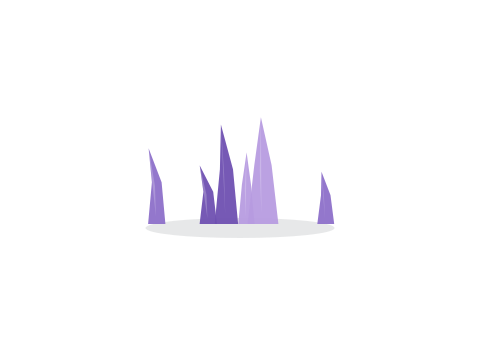
Cast fluorite ore is a type of fluorite ore found in hydrothermal veins. It is a source of fluorine, used in various applications including iron and steel, glass, and mining, and is also a source of uranium, a radioactive element. A report by Maia Research shows the global fluorite market reached $2,006.68 million in 2022 and is expected to reach $2,213.74 million by 2028.
Why Buy Cast Fluorite Ore From Commodity 1?
Fluorite casts from Nigeria often contain up to 95% fluorine, useful for producing fluorinated compounds such as hydrofluoric acid and fluorosilicic acid. Hydrofluoric acid is used in steel, glass, and mining applications; fluorosilicic acid is used to fluoridate drinking water and produce fertilizers.
Commodity 1 provides cast fluorite directly from the mine site to the global market. There are no middlemen involved, only our staff on the ground. We strive to organize smooth and transparent transactions and believe in building long-term relationships with our customers.
| Component | Content (% by weight) |
|---|---|
| Fluorine | 95–97 |
| Calcium | 2.8–3.1 |
| Silicon | 0.01–0.03 |
| Iron | 0.01–0.03 |
| Aluminum | 0.01–0.03 |
| Other | 0.01–0.03 |
Composition varies slightly based on the source and region of Nigeria it is collected from. We encourage buyers to request a free sample for their own composition analysis. Samples are free of cost, but buyers should arrange pickup with a courier service of their choice.
Packaging & Delivery
| Detail | Value |
|---|---|
| Packaging | Lumps |
| Port | Lagos Apapa Port, Nigeria |
| Bags | 50 kg |
| Container | 20 ft |
| Quantity | 20–200 MT per month |
| Lead time | 30 days |
Physical Characteristics
| Characteristic | Description |
|---|---|
| Color | Varies widely — purples, blues, greens, yellows and combinations |
| Transparency | Transparent to translucent to opaque |
| Crystal structure | Typically amorphous, irregular shapes rather than distinct crystals |
| Hardness (Mohs) | 4 — relatively soft |
| Cleavage | Perfect octahedral, though less evident in cast form |
| Luster | Vitreous to sub-vitreous |
| Density | Approx. 3.0–3.3 g/cm³ |
| Streak | White or colorless |
| Fluorescence | Some fluorite fluoresces under UV light |
| Uses | Metallurgy, ceramics, optics, jewelry |
Physical & Chemical Properties
| Property | Value |
|---|---|
| Chemical formula | CaF₂ |
| Molecular weight | 78.07 g/mol |
| Density | 3.18 g/cm³ |
| Melting point | 1,415°C (2,581°F) |
| Boiling point | 1,695°C (3,083°F) |
| Crystal structure | Cubic |
| Hardness (Mohs) | 4 |
| Cleavage | Four perfect cleavages |
| Color | Colorless, white, yellow, green, blue, purple |
| Luster | Vitreous |
| Refractive index | 1.434 |
| Specific gravity | 3.18 |
Industrial Use
| Industry | Usage of Fluorite |
|---|---|
| Metallurgy | Flux in steelmaking and aluminum production to lower melting points |
| Chemical industry | Production of hydrofluoric acid |
| Ceramic and glassmaking | Flux to reduce melting temperature and improve transparency |
| Optical industry | Manufacturing lenses, prisms, and optical components |
| Gem and jewelry industry | Cut into gemstones for jewelry |
| Electronics industry | Production of semiconductors and other components |
| Medical and dental | Source of fluorine in pharmaceuticals and dental products |
| Environmental applications | Water treatment and air pollution control |
| Metallurgical testing | Used as a flux in metallurgical testing processes |